
About Agon
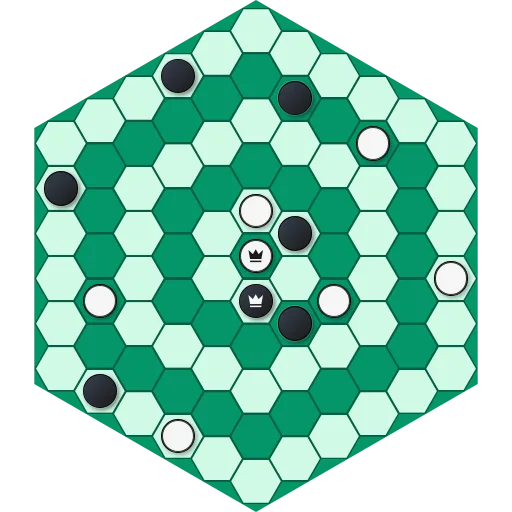
Agon, better known in English as Queen's Guard, is the 1842 abstract strategy game that introduced the hexagonal board to the world. Two players race across 91 hexes arranged in six rings, each escorting one queen and six guards towards the throne at the centre. The movement rule takes seconds to learn: one step per turn, sideways or inwards, never back out.
The depth comes from what those steps cost. No piece is ever removed, so the game is a pure contest of tempo, decided by pincers that send a committed guard all the way back to the rim and by the trap waiting for anyone who rings the throne before their queen arrives. That is a surprising amount of planning for a game with only one kind of move.
Play Agon vs AI
The habit that decides most games of Agon is counting: how many steps does each side still need to finish its formation? Against the computer you can test that count on every move, from the gentle first level up to the strongest.
Practise the pincer that resets an enemy guard, the fences a pair of your own pieces can build across a straight line, and above all the arrival order that keeps you clear of the empty throne forfeit.
How to play Agon
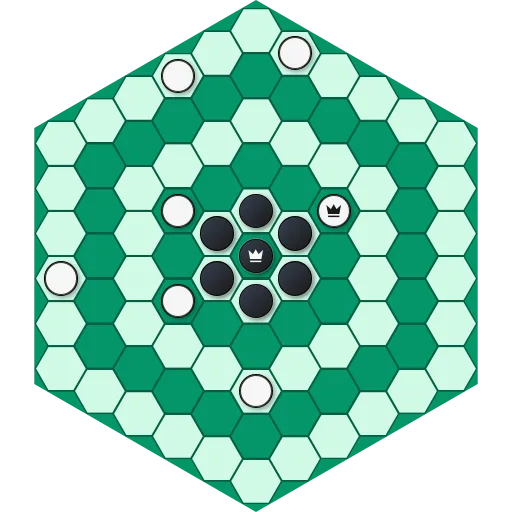
The goal of Agon is to seat your queen on the central throne with all six of her guards on the hexes around her.
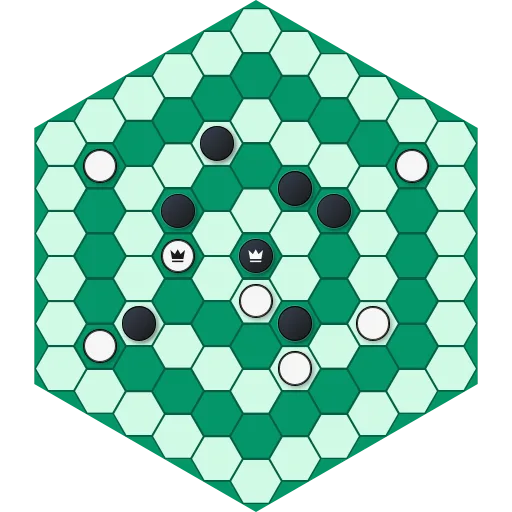
Each side starts with a queen and six guards on the outer ring. On your turn you move one piece one step, sideways within its ring or inwards to the next ring, never outwards, and only the queen may enter the throne. Trapping an enemy piece between two of yours in a straight line sends it back to the rim on its owner's next turn. Ring the throne without your queen on it and you lose.
Improve by learning strategy
Agon strategy is about tempo rather than material. Nothing is ever taken off the board, so the winner is whoever wastes fewer turns getting into formation and forces the opponent to waste more.
Bring your queen home before you close the ring, hunt for pincers against guards that have already committed deep, and read the three straight lines through a cell before you step onto it.
Frequently Asked Questions
You win by moving your queen onto the central throne hex and filling all six hexes around her with your own six guards. Both halves are required. A queen on the throne without her full ring has not won, and a full ring without your queen on the throne loses the game immediately.
No. A piece may step sideways within the ring it stands on, or inwards to the next ring, and never outwards. The only way a piece ever goes back out is by being caught between two enemy pieces, which forces its owner to spend a turn returning it to the outer ring.
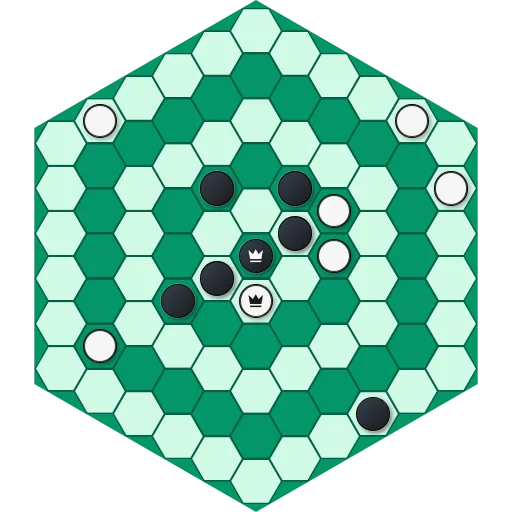
Nothing leaves the board. A piece caught between two enemy pieces in a straight line must be picked up by its owner on their next turn and put back down: a guard on any vacant cell of the outer ring, the queen on any vacant cell of the board. Only one caught piece is returned per turn, and a caught queen goes back before any caught guard.
The six cells around the throne are the only way in, so a player who fills them all without their queen on the throne has sealed their own queen out of the game. The rules settle it directly by declaring that player the loser, which turns the winning formation into a puzzle of arrival order rather than a simple race.
Agon was published in London in 1842 and is the oldest known board game played on a board of hexagonal cells. Victorian sets were sold under several names, and Queen's Guard is the one that stuck in English, because the whole game is the story of six guards escorting their queen to her throne.
Similar games you might like
If you enjoy Agon, you will probably like these other abstract strategy board games.
Learn, Play, and Have Fun!
Ready to play Agon online? Start a match against the computer now. No signup, no friction.