
Play Go online for free, right in your browser: against the computer, with a friend online, or with two players on one device. Games here are on the 9 by 9 board, the size most players learn on, so a game takes minutes, not hours. No download and no sign-up.
Ways to play Go online










More ways to play
Read the guides
What is Go?
Go is a two-player strategy board game, called Weiqi in China and Baduk in Korea. Black and White take turns placing a stone on an empty point of the board. Stones never move, but a stone or group that is completely surrounded is captured and taken off. At the end, the player who controls more of the board wins.
The rules are few and simple, yet Go is one of the deepest games ever played. This site plays on the 9 by 9 board with Chinese area scoring and a komi of 7.5 points for White. The full rules explain every detail.
Go has no pieces of different strength and no king to protect. Every stone is the same, and its value comes only from where it stands and what stands next to it. That makes the first games easy to start and the game itself hard to exhaust: players study it for a lifetime.
The 9 by 9 board keeps every rule and idea of the full game, from capturing to life and death, in a game of ten to twenty minutes. It is the board most beginners learn on, and strong players use it for quick, sharp games.
How to play Go in one minute
- The board starts empty. Black places the first stone, then the players take turns, one stone per turn, on any empty point.
- The empty points next to a stone, along the lines, are its liberties. Stones of one colour that touch along a line share their liberties.
- Take away the last liberty of a stone or group and it is captured and removed from the board.
- You may not play a stone that would have no liberty, unless it captures. You may not retake a ko at once.
- When both players pass, the game ends. Each side counts its stones plus the empty points it surrounds, White adds komi, and the higher score wins.
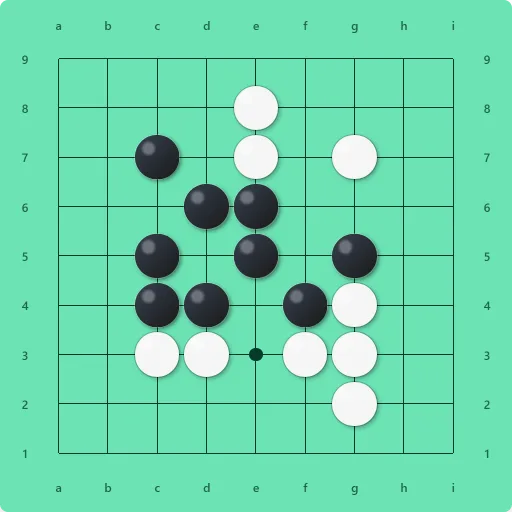
Make your move on the board.
Show the answer
f4. The white stone on f3 is surrounded by black stones on e3, g3 and f2. Its last liberty is f4, and a black stone there captures it.
That is the whole game. The full Go rules explain liberties, capturing, ko and how the score is counted, each with a simple diagram, and you can play the computer at once on an easy level.
Go strategy in three ideas
Go strategy is a lifetime's study, but three ideas carry a beginner a long way.
The Go strategy guide goes further: where to play first, connecting and cutting, ladders, liberty races, the vital point of a group and closing your borders, with positions you can play.
Go rule sets and board sizes
All rule sets agree on how stones are placed and captured. They differ in how the score is counted, how much komi White gets and how repeated positions are handled. In nearly every game, the different rules give the same winner.
| Rule set | What counts | Usual komi |
|---|---|---|
| Chinese (area scoring, this site) | Your stones on the board plus the empty points you surround | 7.5 |
| Japanese and Korean (territory scoring) | The empty points you surround plus the stones you captured | 6.5 |
| AGA (American Go Association) | Area or territory; a stone handed over with each pass makes both counts agree | 7.5 |
| New Zealand | Area, as in the Chinese rules; suicide of several stones is allowed | 7 |
History and other names
Go comes from China, where it was already played more than 2,500 years ago, which makes it one of the oldest board games still played in its original form. Early boards had 17 by 17 lines; 19 by 19 has been the standard for well over a thousand years.
From China the game spread to Korea and Japan. In Japan the shogunate of the Edo period supported houses of professional players, and professional Go is still organised in Japan, China, Korea and Taiwan. In 2016 the program AlphaGo beat the top professional Lee Sedol, the first time a computer beat a player of that level on the full board, and computer analysis has changed how professionals play ever since.
Go has many names: Weiqi (围棋), the surrounding game, in Chinese; Igo (囲碁) or Go in Japanese, the source of the English name; Baduk (바둑) in Korean; Cờ vây in Vietnamese and Mak lom (หมากล้อม) in Thai.
Go questions
The rules are among the simplest of any board game: place a stone, capture what you surround, and count at the end. You can play a first game within minutes. Playing well takes much longer, which is what keeps people playing for years.
The 9 by 9 board has every rule of the full 19 by 19 game, and a game takes ten to twenty minutes instead of an hour or more. It is the board most players learn on, and the tactics you learn there carry over directly to the bigger boards.
Black moves first. Moving first is an advantage, so White receives extra points called komi. This site gives White 7.5 points, the komi of the Chinese rules. The half point means a game can never end in a tie.
When there is nothing left to gain, you pass instead of placing a stone. When both players pass in a row, the game ends. A good sign that it is time to pass: every border between your stones and your opponent's is closed, and no group is left in danger.
Chinese area scoring: each side counts its stones on the board plus the empty points it surrounds, and White adds 7.5 komi. Japanese territory scoring counts surrounded points plus captured stones instead. The two methods almost always give the same winner.
Not here: with 81 points to share and a komi of 7.5, one side always has more. With a whole-number komi a tie, called jigo, is possible, and under Japanese rules a rare endless repetition such as a triple ko can void the game.
They share the board and the stones, and little else. In Gomoku the first to make five in a row wins and no stone is ever captured. In Go you surround territory and capture stones, and the game is decided by the count at the end.
When players of different strength meet, the weaker player takes Black and places two or more stones on the board before White's first move. The site's computer opponents adjust their strength by level instead.
Yes. Start a game with a friend and send them the invitation, and you play live on the same board, each on your own device.
No. Go runs in your browser on a computer, phone or tablet, including iPhone and Android. An account is optional and only keeps your game history and stats.
Similar games you might like
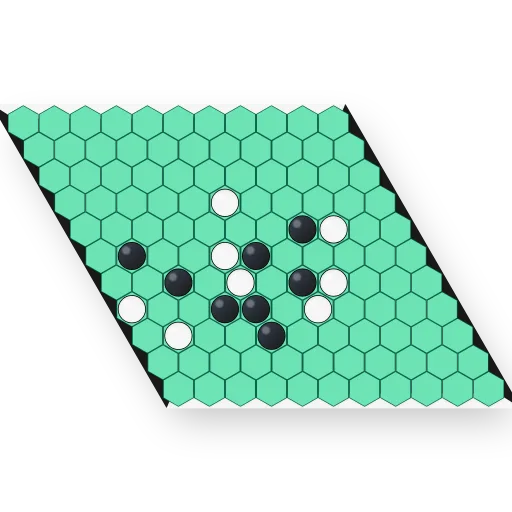
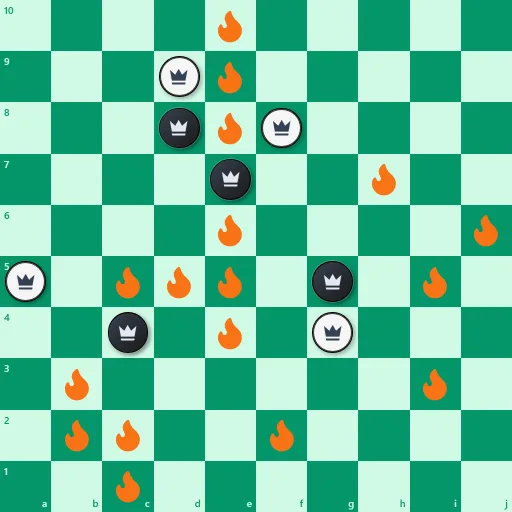
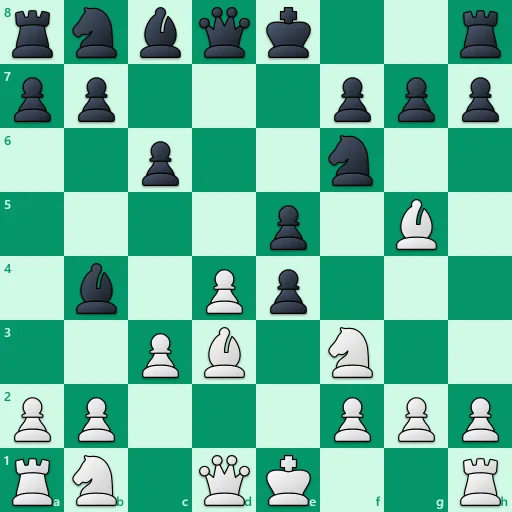
If you enjoy Go, you will probably like these other abstract strategy board games.
Learn, Play, and Have Fun!
Ready to play Go online? Start a match against the computer now. No signup, no friction.