
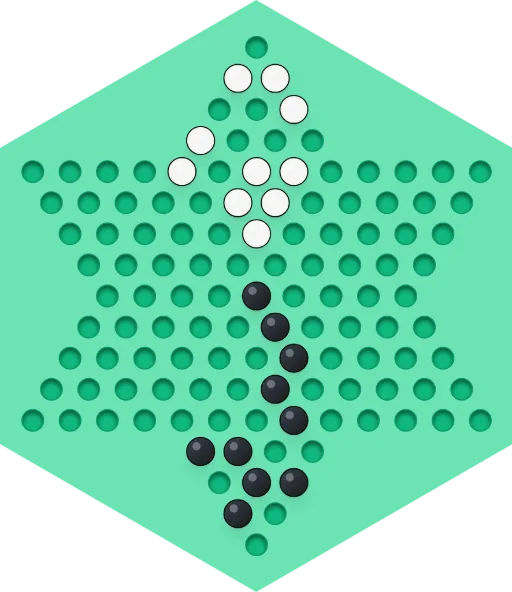
Play Chinese Checkers online for free, right in your browser: against the computer, with a friend online, or with two players on one device. No download and no sign-up. New to the game? The rules take a minute.
Ways to play Chinese Checkers online










More ways to play
Learn
Chinese Checkers rulesSteps, jumps, chains of jumps and how to win, with diagrams.Read the rulesRead the guides
What is Chinese Checkers?
Chinese Checkers is a race game for two to six players on a board shaped like a six-pointed star, with 121 holes. Each player starts with ten marbles in one point of the star and tries to be the first to move all of them into the point straight across.
A marble moves one hole at a time, or jumps over another marble, and a chain of jumps can carry it right across the board in a single turn. Nothing is ever captured: every marble stays on the board, and the marbles in your way are the ones you jump over.
This site plays the two-player game: Black against White, ten marbles each, starting in opposite points.
The rules fit in two sentences, and a child can play a full game. Yet every turn asks the same question in a new form: which marble can go furthest, and what does that leave behind for the next move?
Long chains of jumps are the fun of it. Building them, for yourself and never for your opponent, is the skill.
How to play Chinese Checkers in one minute
- Each player starts with ten marbles in one point of the star. Black moves first.
- On your turn, move one marble: either a step to a neighbouring empty hole, or a jump over one marble next to it into the empty hole just beyond.
- After a jump you may jump again with the same marble, as often as you can, in any direction. A step ends your turn.
- Marbles are never captured. The first player to fill the opposite point wins. An opponent's marble that never left it does not block you: it counts towards the full point.
Make your move on the board.
Show the answer
Move the marble at the tip of Black's point. It hops over three black marbles in a row and lands six rows up, ahead of every other black marble. The marbles that moved out first are its stepping stones.
That is the whole game. The full Chinese Checkers rules cover chains of jumps, the end of the game and the rules that differ from house to house, with diagrams for each.
Chinese Checkers strategy in three ideas
A game of Chinese Checkers is a race, and the fastest player is not the one who makes the single longest jump. These three ideas decide most games.
The Chinese Checkers strategy guide explains each idea with positions you can play, plus the opening, blocking and how to finish quickly.
Players, boards and variants
The star board was made for up to six players, and families play it in many ways. Most versions keep the same moves and change only the number of players or the shape of the board. Super Chinese Checkers, also called fast-paced Chinese Checkers, changes the jump: a marble may jump over a single marble further along a straight line, as long as the holes between them are empty, and it lands as far beyond that marble as it started before it, on an empty path. Long jumps then come up on almost every move, so games go much faster.
| Version | Players | Marbles each | Played here |
|---|---|---|---|
| Two players | 2, in opposite points | 10 (some sets use 15) | Yes, with 10 |
| Three, four or six players | 3 in every other point, 4 in two pairs of opposite points, or 6 in all six | 10 | No |
| Diamond Game | 2, on a diamond of 81 holes: the star without its four side points | 10 | No |
| Super Chinese Checkers | 2 to 6 | 10 | No |
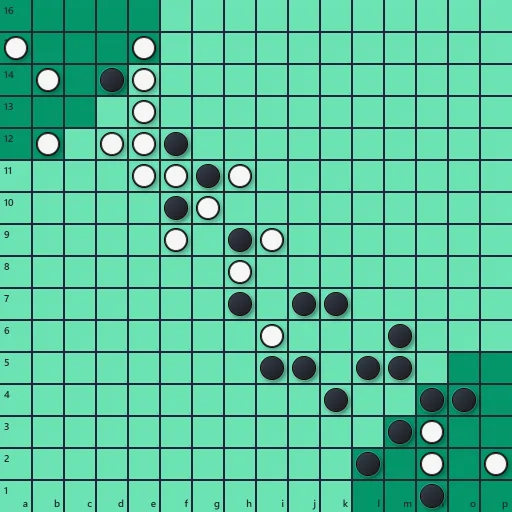
| Halma | 2 or 4, on a square board of 16 by 16 | 19 with two players, 13 with four | As Halma |
History and other names
Despite its name, Chinese Checkers comes from neither China nor Checkers. It grew out of Halma, a game invented in the United States in the 1880s and played on a square board. In 1892 the German publisher Ravensburger brought out a version on a star-shaped board as Stern-Halma, star Halma, which let more players race at once.
In 1928 the game was sold in the United States as Hop Ching Checkers and then as Chinese Checkers, an exotic name chosen for marketing. The name stuck, and the game later spread across East Asia, where it is popular to this day.
Other names include Sternhalma and Stern-Halma in German, 跳棋 (tiàoqí, jumping chess) in Chinese, ダイヤモンドゲーム (Diamond Game) in Japanese and 다이아몬드 게임 in Korean.
Chinese Checkers questions
No. It was first published in Germany in 1892 as Stern-Halma, a star-shaped version of the American game Halma. The name Chinese Checkers was given to it in the United States in 1928 for marketing. It has nothing to do with Checkers either.
Ten, filling one point of the star. Some sets give two players 15 marbles each, but ten is the standard and what this site plays.
Yes. You can jump over any marble, your own or your opponent's, as long as the hole right behind it is empty. The marble you jump over is not captured and stays where it is.
Yes. After a jump the same marble may jump again, in any direction, as many times as it can. You may stop after any jump. You cannot add a step to a chain of jumps, and a step on its own ends your turn.
Yes. Steps and jumps go in any of the six directions. Moving back is rarely good for its own sake, but a marble that steps back can become the rung another marble needs.
It cannot block you. On this site you win as soon as every hole of the opposite point is filled and at least one of them holds your own marble, so your opponent's marbles that never left count towards the full point. Keeping marbles back only slows their owner down. Some house rules handle it differently, for example by letting you swap places with the marble in the way.
Two to six on the star board, with two, three, four or six being the usual numbers. This site plays the two-player game, against the computer, a friend online or on one device.
They are close relatives. Halma came first and is played on a square board of 16 by 16 with more pieces. Chinese Checkers moves the same way on a star-shaped board. You can play Halma here too.
Yes. Choose Play a friend, send the link to your friend and play live on the same board. It is free, and neither of you needs an account.
No. Chinese Checkers runs in your browser on a computer, phone or tablet, including iPhone and Android. An account is optional and only keeps your game history and stats.
Similar games you might like
If you enjoy Chinese Checkers, you will probably like these other abstract strategy board games.
Learn, Play, and Have Fun!
Ready to play Chinese Checkers online? Start a match against the computer now. No signup, no friction.