
Play Gomoku online for free, right in your browser: against the computer, with a friend online, or with two players on one device. No download and no sign-up. New to five in a row? The rules take a minute.
Ways to play Gomoku online










More ways to play
Read the guides
More puzzles
What is Gomoku?
Gomoku is a two-player strategy board game, also called five in a row or Gobang. Black and White take turns placing one stone on an empty point of a 15 by 15 grid, and the first player to make an unbroken line of five stones, across, down or diagonally, wins. Stones never move and are never captured.
This site plays freestyle Gomoku, where five or more in a row wins. Renju and the other rule sets are compared below.
The rules fit in a sentence, so a game can start in seconds, yet every move is a small puzzle: build your own lines while you watch the lines your opponent is building.
Most games are decided by a double threat, two threats made with a single stone. Learning to spot them, for yourself and for your opponent, is a skill that keeps growing, and a game rarely takes long, so there is always time for one more.
How to play Gomoku in one minute
- The board starts empty. Black places the first stone, then the players take turns.
- On your turn, put one stone on any empty point where two lines cross.
- Stones never move and are never removed.
- Make an unbroken line of five or more, across, down or diagonally, and you win at once.
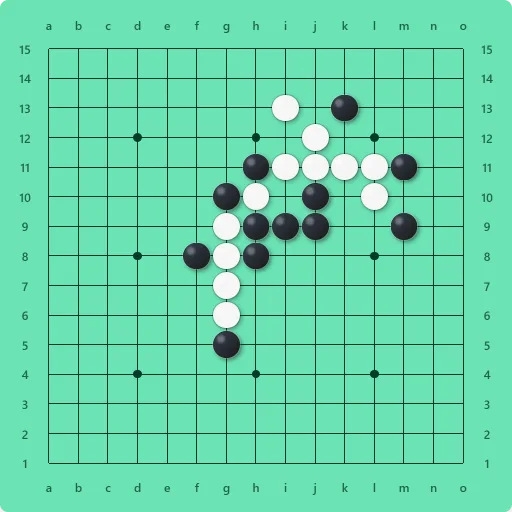
Make your move on the board.
Show the answer
m9. Black's four from i9 to l9 is blocked at h9 by White, so the open end at m9 completes the five.
That is the whole game. The full Gomoku rules cover six in a row, draws and the words players use for threats, and the tutorial lets you play your first winning line step by step.
Gomoku strategy in three ideas
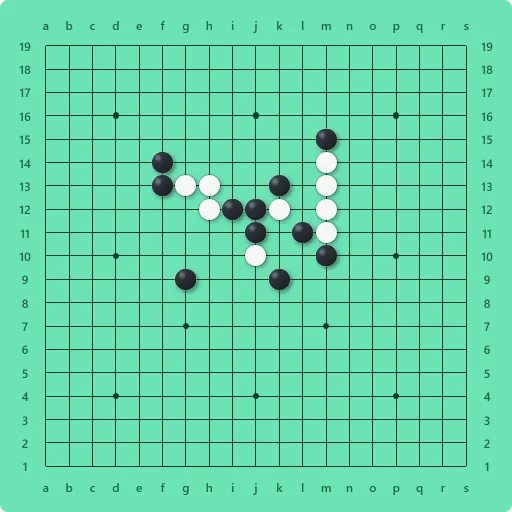
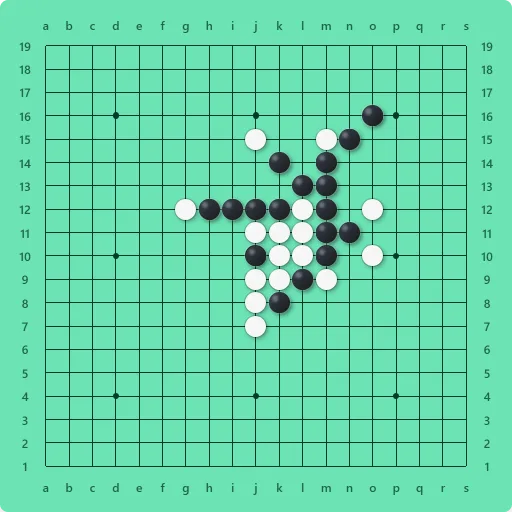
Most games of Gomoku are won by a threat the opponent cannot answer. These three shapes are where every attack starts.
The Gomoku strategy guide shows how to build these threats, win by continuous fours and defend in time, with positions you can play.
Watch Gomoku videos
Short videos on the rules, the tactics and strong games, picked to help you improve.
Gomoku rule sets: freestyle, Renju and more
Five in a row is played under several rule sets. They agree on the board and the goal and differ in which lines count and how the first move is balanced.
| Rule set | What counts as a win | Other rules |
|---|---|---|
| Freestyle (this site) | Five or more in a row | None. Black moves first. |
| Standard Gomoku | Exactly five; six or more does not win | Often combined with an opening rule such as Swap2. |
| Renju | Five; White also wins with six or more | Black may not make a double three, a double four or six in a row. Fixed opening procedures. |
| Caro (Vietnam) | Five, but not when both ends are already blocked | Usually played on a larger grid or on squared paper. |
| Swap2 opening | Depends on the rule set it is used with | The first player places two black stones and one white. The second player then picks a colour, or adds two more stones and lets the first player pick. |
History and other names
Gomoku comes from Japan, where it was played with Go stones on a Go board, which is why the stones sit on the points rather than in the squares. The name comes from Gomokunarabe, roughly five stones in a row.
In 1899 the journalist Kuroiwa Ruikō gave the game the name Renju, and the tournament form later added restrictions on Black to balance the first move. By the late 19th century the game had also reached Britain, where it was sold as Go-Bang. Today it is played under many names, from Wuziqi in China to Omok in Korea and Caro in Vietnam.
Gomoku goes by many names: five in a row, Gobang, Gomokunarabe and 五目並べ in Japanese, 五子棋 (Wuziqi) in Chinese, 오목 (Omok) in Korean and Caro in Vietnamese.
Gomoku questions
Yes. Five in a row, Gobang and Gomokunarabe are names for the same idea: be the first to line up five stones. Rule sets differ in the details, such as whether six in a row counts. This site plays freestyle Gomoku, where five or more in a row wins.
Black always goes first. With perfect play Black wins freestyle Gomoku on a 15 by 15 board, which was proven with a computer search in 1994. Between human players the advantage is real but much smaller, and against the computer you can choose your colour.
They share the board and the stones, and little else. In Go you surround territory and capture stones. In Gomoku no stone is ever captured, and the only goal is five in a row.
Renju is the tournament form of Gomoku. Black may not make a double three, a double four or six in a row, and fixed opening procedures balance the first move. The rules page compares Renju with the other common rule sets.
Only if all 225 points are filled without a five. That is very rare, because one player usually runs out of defences long before the board is full.
Yes. Start a game with a friend and send them the invitation, and you play live on the same board, each on your own device.
No. Gomoku runs in your browser on a computer, phone or tablet, including iPhone and Android. An account is optional and only keeps your game history and stats.
Most games end long before the board fills up: a casual game takes 5 to 20 minutes, and a quick game against the computer at a low level a few minutes.
Black usually starts on the centre point, h8 on this board, because a stone there has the most room to grow lines in every direction. The strategy guide shows the common replies for White.
Similar games you might like
If you enjoy Gomoku, you will probably like these other abstract strategy board games.
Learn, Play, and Have Fun!
Ready to play Gomoku online? Start a match against the computer now. No signup, no friction.