
About Alquerque
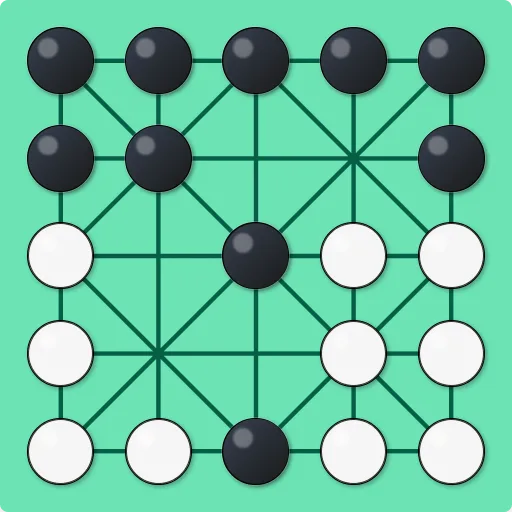
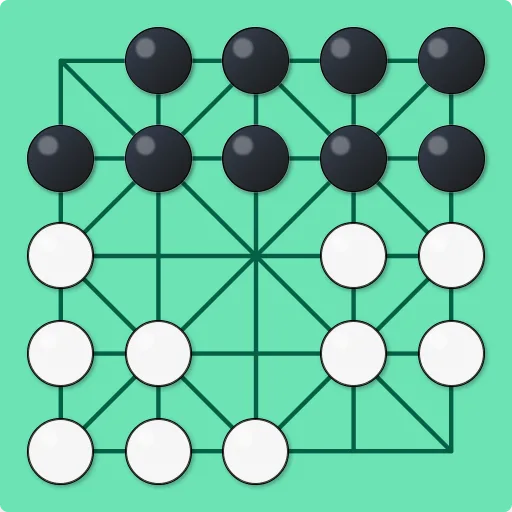
Alquerque is the thousand year old capture game that draughts and checkers descend from. The board is a 25 point lattice of 5 rows and 5 columns laced with diagonals, and each side lines up 12 stones with only the centre point left empty.
The mechanic will feel instantly familiar and still play like nothing else. You jump an adjacent enemy stone to the empty point beyond it and take it, jumps chain, and capturing is compulsory, but stones move along the lattice in every direction and never promote.
Play Alquerque vs AI
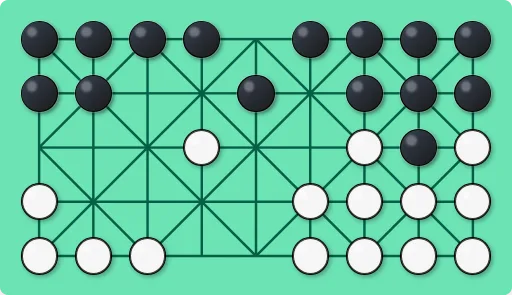
Alquerque punishes whoever misses a chain. Against the computer, work on spotting every multi-jump on the board and on reading which leaps your own move forces on your opponent, since captures are compulsory.
Advance in pairs, so that a stone which gets jumped can be avenged at once, and occupy the points where the diagonals cross, since a stone there can move in eight directions.
How to play Alquerque
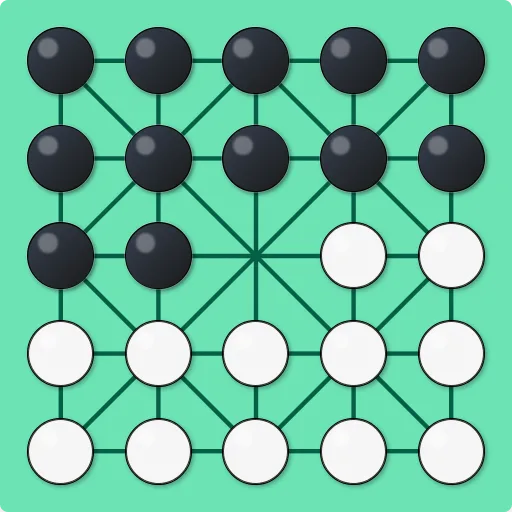
The goal of Alquerque is to capture all 12 of your opponent's stones on the 5 by 5 point board.
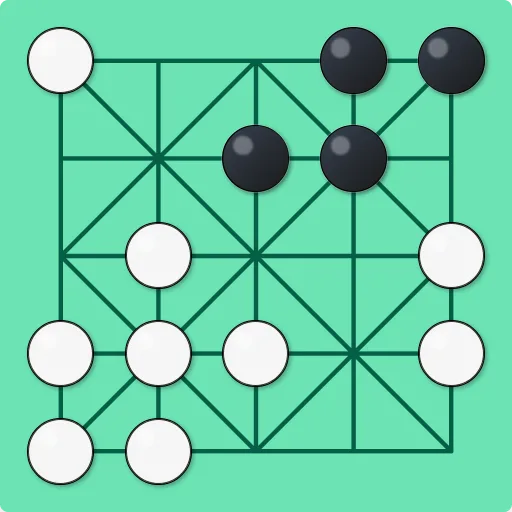
Move one step along a line to an empty point, or jump straight over an adjacent enemy stone to the empty point beyond it and remove it. Captures are compulsory and chain together, and diagonal moves are only available from the strong intersections where all eight lines meet.
Improve by learning strategy
Alquerque strategy is about spacing and timing. Strong players look for landing points that keep a chain alive and think about which capture their move forces on the opponent.
Hold the strong intersections where all eight lines meet, keep a stone behind any piece that could be jumped, and fight for the empty centre without walking into the first exchange.
Frequently Asked Questions
Alquerque is a two player abstract strategy game from the medieval Middle East and Spain, played on a 25 point board of 5 rows and 5 columns with 12 stones per side. It is the direct ancestor of draughts and checkers, and the goal is to capture all of the opponent's stones by jumping over them.
You capture by jumping a stone straight over an adjacent enemy stone to the empty point immediately beyond it, along one of the board's lines, and removing the stone you jumped. Only one stone is taken per leap, and a diagonal jump is only possible from a strong intersection where all eight lines meet.
Yes. If any jump is available you must play one, and quiet single steps are only legal when no capture exists anywhere on the board. Continuing is compulsory too: a stone that has just jumped and can jump again must keep going until it runs out of leaps.
Alquerque is played on the lines and intersections of a 5x5 lattice rather than on the dark squares of a chequered board, and stones move and jump in every direction the lines allow rather than only forward. There is no promotion to a king, so every stone keeps the same powers from the first move to the last.
The game appears as qirkat in Arabic writing from the tenth century and reached Spain with the Moors, where its rules were written down in the Libro de los juegos commissioned by Alfonso X in the thirteenth century. Moving it on to the squares of a chess board is what produced draughts around the twelfth century.
Similar games you might like
If you enjoy Alquerque, you will probably like these other abstract strategy board games.
Learn, Play, and Have Fun!
Ready to play Alquerque online? Start a match against the computer now. No signup, no friction.