
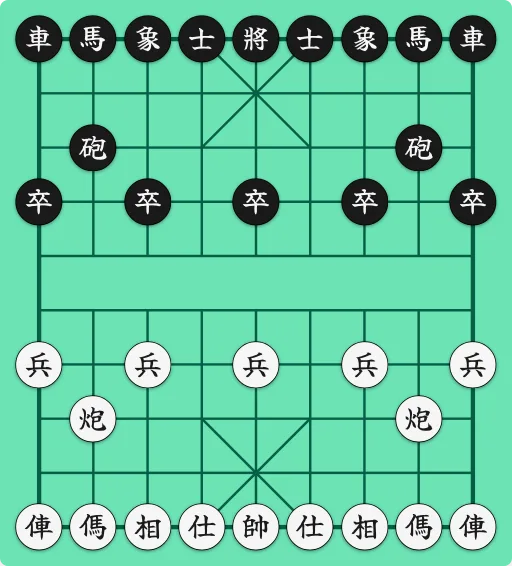
About Chinese Chess
Chinese Chess, also known as Xiangqi, is a two-player strategy game played on a 9x10 board divided by a river, with each general confined to a guarded palace. Two armies of sixteen pieces maneuver to checkmate the enemy general.
Its distinctive cannons, blocked horses and elephants, and the flying-general rule give Chinese Chess a rich tactical character that rewards both bold attacks and patient defense. Red moves first, and the first to trap the enemy general wins.
Play Chinese Chess vs AI
Chinese Chess has cannons that capture by jumping a screen, and generals that may never face each other on an open file. Against the computer you can learn the openings, sharpen your tactics and get comfortable defending the palace.
The cannon is strongest early, when the board is crowded with screens, while the horse grows stronger as the board empties. Keep that in mind whenever you trade pieces.
How to play Chinese Chess
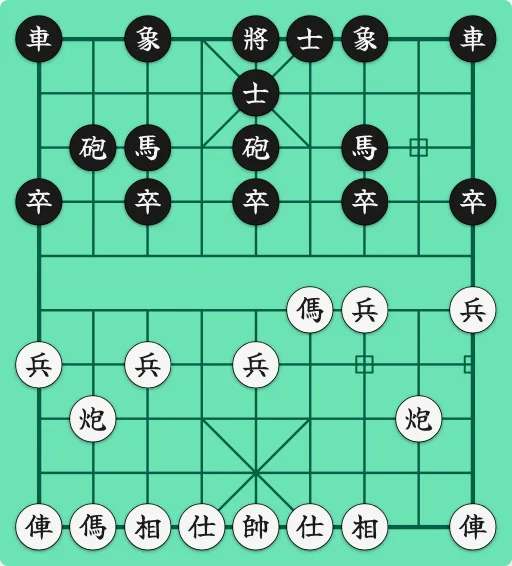
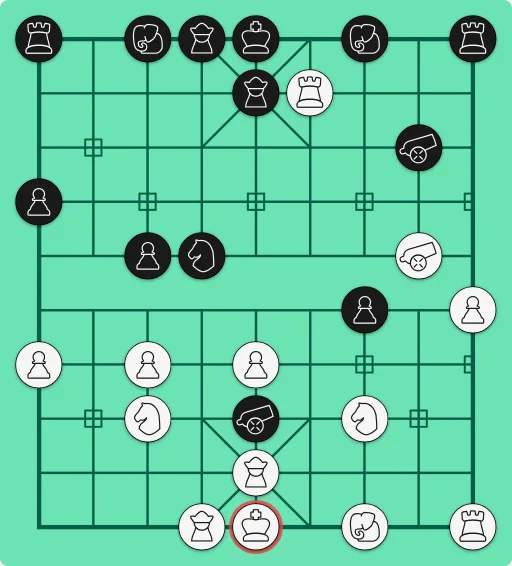
Chinese Chess rules reward understanding how each piece works: chariots sweep open lines, cannons need a screen to capture, horses and elephants can be blocked, and soldiers gain sideways movement after crossing the river.
The general and advisors never leave the palace, elephants never cross the river, and the two generals may never face each other on an open file, a rule that creates many surprising tactics.
Improve by learning strategy
Strong Chinese Chess strategy balances a fast attack with a solid palace. Open lines for your chariots, use the central cannon to pressure the enemy general, and manage screens to control cannon threats.
Keep your advisors and elephants coordinated in defense, watch the flying-general file, and aim to convert an initiative into a decisive checkmate before your opponent untangles.
Frequently Asked Questions
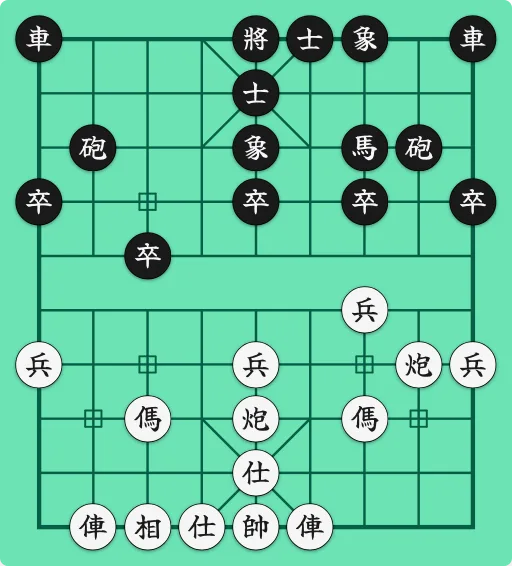
You win by checkmating the enemy general, meaning it is under attack and cannot avoid capture next move. You also win if your opponent has no legal move, because stalemate counts as a loss in Chinese Chess. Protecting your own general while cornering your opponent's is the heart of the game.
Chinese Chess is played on the lines of a 9x10 board with a river and palaces, and it adds the cannon, which captures by jumping a screen piece. The general and advisors are locked inside the palace, elephants cannot cross the river, and pawns never promote. These features give Chinese Chess a very different feel from Western chess.
A cannon moves like a chariot along ranks and files when not capturing. To capture, it must jump exactly one piece of either color, called the screen, and land on an enemy piece directly beyond it. Without a screen it cannot capture at all.
The flying general rule forbids the two generals from sitting on the same file with no pieces between them. If they did, one general could fly across and capture the other. In practice this means you cannot make a move that leaves your general exposed to the enemy general along an open file.
Yes. If neither side can force a checkmate, the game can be drawn, for example when the same position repeats or when too little material remains to win. Tournament rules add detailed conditions about perpetual check and chasing, but casual play usually treats endless repetition as a draw.
Similar games you might like
If you enjoy Chinese Chess, you will probably like these other abstract strategy board games.
Learn, Play, and Have Fun!
Ready to play Chinese Chess online? Start a match against the computer now. No signup, no friction.