
About Mancala
Mancala (often played as Kalah) is a classic sowing and capturing game where each move redistributes stones around the board. Your goal is to collect more stones in your store than your opponent.
The tactics are intuitive, but strong play comes from counting where the last stone will land and setting up extra turns or captures while preventing your opponent from doing the same.
Play Mancala vs AI
Mancala rewards counting: before you sow, work out where your last stone will land. Against the computer, practise planning moves that earn an extra turn and sequences that chain several of them.
Focus on moves that give an extra turn, and watch for capture opportunities created by landing your last stone in an empty pit on your side.
How to play Mancala
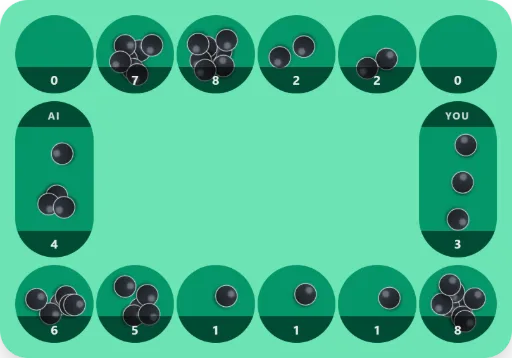
On each turn you pick up all stones from one pit on your side and sow them counter-clockwise, placing one stone per pit.
Landing your last stone in your store grants an extra turn. Landing your last stone in an empty pit on your side can capture stones from the opposite pit, depending on the variant rules.
Improve by learning strategy
Mancala strategy is about initiative. Extra turns let you control the pace, so prioritize moves that end in your store when they are safe.
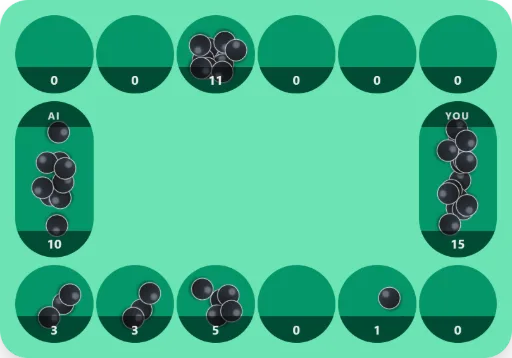
In the endgame, count remaining stones and avoid emptying your side too early if it lets your opponent scoop a large final capture.
Frequently Asked Questions
Mancala games originated in Africa and the Middle East, with archaeological evidence dating back over 3,000 years. The name 'Mancala' comes from the Arabic word 'naqala' meaning 'to move.' It spread globally through trade routes and colonization, developing into hundreds of regional variants.
These are all variants of the Mancala family of games. Kalaha (also called Kalah) is the version most popular in the Western world, featuring capture rules and extra turns. Oware is the West African variant with slightly different capture rules. The version played here follows Kalaha rules.
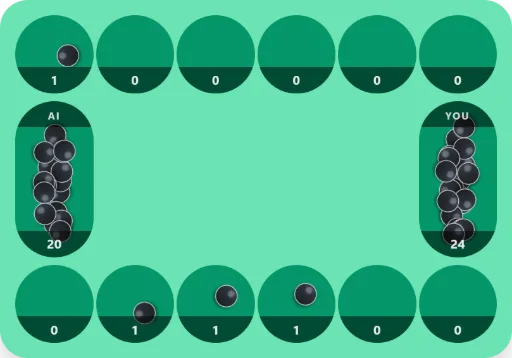
Yes, if both players end with exactly 24 stones each (half of the 48 total stones), the game is a draw. This is relatively uncommon but possible.
Yes, the first player has a slight advantage in Mancala. With perfect play, the first player can always win or draw. However, this advantage is small enough that the game remains competitive between human players.
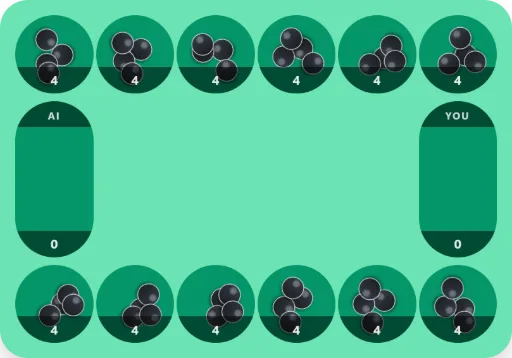
Traditional Mancala uses 48 stones total, with 4 stones in each of the 12 playing pits. Some variants use different numbers, but 48 is standard for the Kalaha version played here.
Similar games you might like
If you enjoy Mancala, you will probably like these other abstract strategy board games.
Learn, Play, and Have Fun!
Ready to play Mancala online? Start a match against the computer now. No signup, no friction.