
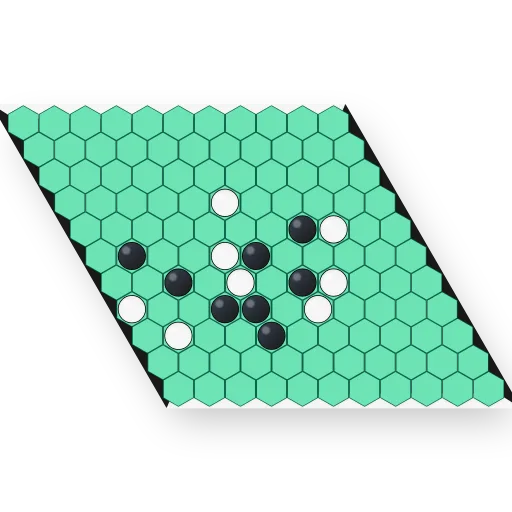
About Hex
Hex is a pure connection strategy board game. There are no captures and no draws: one player will always connect their sides first.
Because every stone can influence multiple paths, Hex rewards long-term planning, pattern recognition, and calm defense under pressure.
Play Hex vs AI
A game of Hex can never end in a draw: someone always connects their two sides. Against the computer, practise planning a connection and learn how to respond when it threatens to cut your path.
As you improve, focus on building connected shapes and using bridge patterns that are hard to block.
How to play Hex
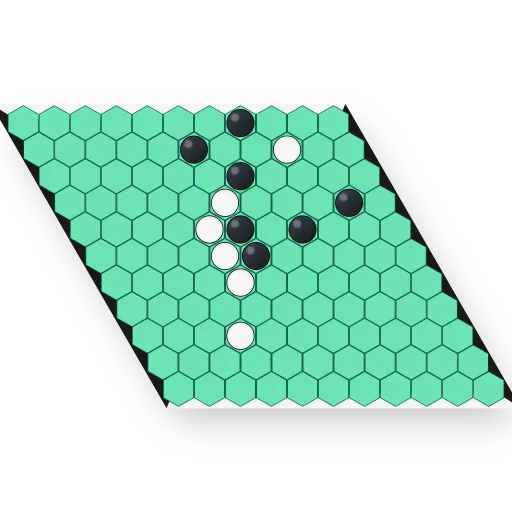
Hex rules are simple: players alternate placing stones on empty hexes. Stones never move and are never captured.
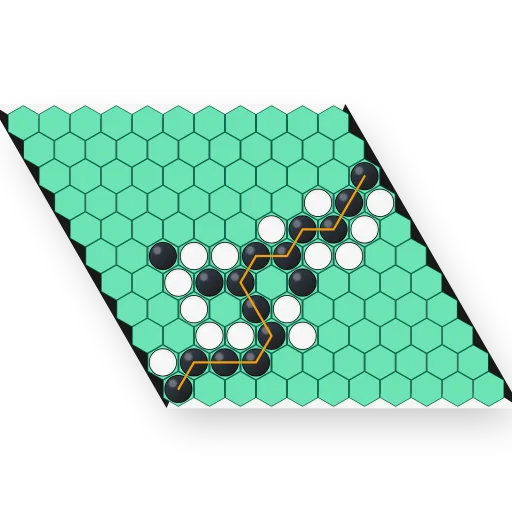
To win, connect your two opposite sides with an unbroken chain of your stones. Since the board has no draws, every game ends with a winner.
Improve by learning strategy
Good Hex strategy is about connecting while preventing connections. Build multiple routes and make it difficult for your opponent to cut all of them.
Learn common bridge shapes and templates so you can see connections that are guaranteed even if your opponent tries to block them.
Frequently Asked Questions
Hex was invented independently by two mathematicians: Piet Hein in Denmark (1942) and John Nash at Princeton (1948). Nash, who later won the Nobel Prize in Economics, proved that the first player has a winning strategy, though the strategy itself remains unknown.
This is a beautiful mathematical property of the game. If you completely fill a Hex board, exactly one player must have a winning connection. It is impossible for both to be blocked. This was proven using topological arguments about connected paths.
With perfect play, yes, the first player can always win. John Nash proved this using a 'strategy-stealing' argument. However, the actual winning strategy is unknown for standard board sizes, so both players have real winning chances in practical play.
To balance the first-player advantage, the 'swap rule' (or 'pie rule') allows the second player to swap colors after the first move. This encourages the first player to make a moderately strong opening, knowing a too-strong move will be stolen.
The standard competitive board is 11×11. Smaller boards (7×7 or 9×9) are good for learning and faster games. Larger boards (13×13, 19×19) offer even more strategic complexity. The game works on any size from 4×4 upward.
Similar games you might like
If you enjoy Hex, you will probably like these other abstract strategy board games.
Learn, Play, and Have Fun!
Ready to play Hex online? Start a match against the computer now. No signup, no friction.