
Play Chess online for free, right in your browser: against the computer, with a friend online, or with two players on one device. No download and no sign-up. New to the game? The rules below show how every piece moves.
Ways to play Chess online









More ways to play
Read the guides
What is Chess?
Chess is a two-player strategy board game played on a board of 64 squares, eight by eight. Each player starts with 16 pieces: a king, a queen, two rooks, two bishops, two knights and eight pawns. Every kind of piece moves in its own way, and you win by checkmate: attacking your opponent's king so that it cannot escape.
Chess is played by millions of people, online and in clubs and tournaments in almost every country, always with the same rules.
There is no luck and nothing hidden: both players see the whole board, and the better plan wins. The rules fit on one page, yet no two games are alike, and strong players still find new ideas after a lifetime of play.
You do not need to know openings to enjoy it. A few principles and an eye for loose pieces win most games between beginners, and the strategy guide starts there.
How to play Chess
- White moves first, then the players take turns, one move each.
- Each piece moves in its own way: the rook in straight lines, the bishop diagonally, the queen in both ways, the king one square, the knight in an L, and the pawn forward.
- You capture by moving onto a square held by an opposing piece, which leaves the board.
- An attack on the king is check, and you must get out of it at once. You win by checkmate: a check your opponent cannot escape.
- Three special moves complete the rules: castling, en passant and promotion.
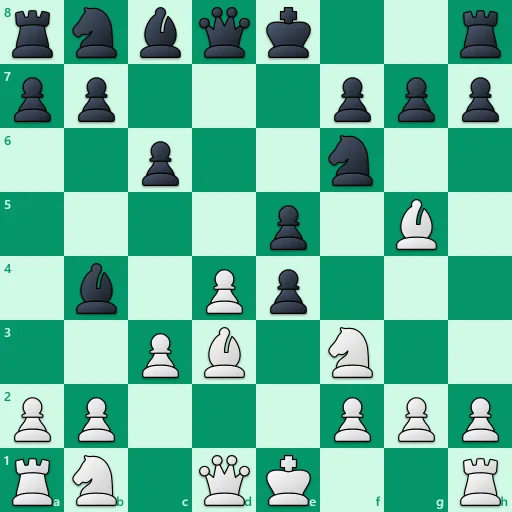
Make your move on the board.
Show the answer
Qxf7#. This is Scholar's mate. Black's 3...Nf6 attacked the queen but left f7 undefended; 3...g6 or 3...Qe7 would have stopped the mate.
That is the core of the game. The full Chess rules explain every piece, check and checkmate, castling, en passant, promotion and the ways a game is drawn, with a diagram for each.
Chess strategy in three ideas
Most games between beginners are decided by a piece left where it can be taken for free. Once you check for that before every move, these three ideas carry you a long way.
The Chess strategy guide explains piece values, opening principles, king safety, tactics and the endgame, with positions you can play.
Chess, its versions and its relatives
Chess is played with the same rules in clubs, tournaments and online all over the world: the Laws of Chess of FIDE, the international federation. That is the game on this site. Popular versions change the starting position or the time each player has.
| Version | What changes | Played here |
|---|---|---|
| Standard Chess | Nothing: the rules on the rules page | Yes |
| Chess960 | The pieces on the back rank start in one of 960 shuffled orders | No |
| Rapid, blitz and bullet | The same rules with a clock, from about an hour down to a minute per player | Same rules, without the clock |
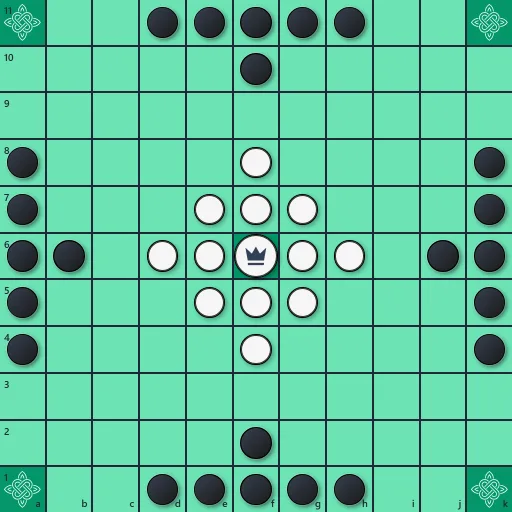
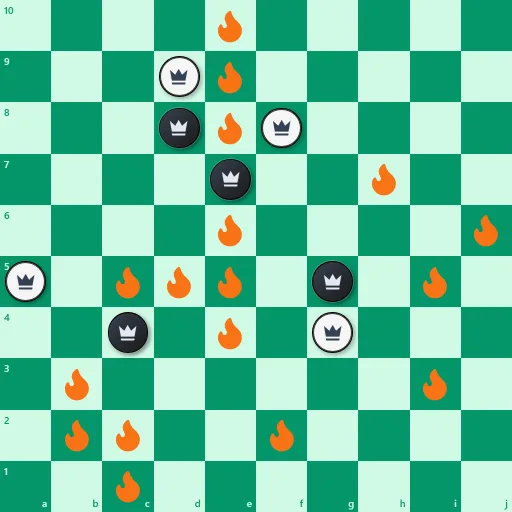
Chess is one branch of a family that grew from the same old Indian game. On this site you can also play Xiangqi, Chinese Chess with its river and palace, Shogi, Japanese Chess in which captured pieces come back into play, Janggi, Korean Chess, and Makruk, Thai Chess, which is still close to the medieval game.
History and other names
Chess grew out of Chaturanga, a game played in India around the 6th century. It travelled to Persia, where it was called Shatranj, spread with the Islamic world across North Africa to Spain, and had reached most of Europe by about the year 1000.
The modern game took shape in southern Europe in the late 15th century, when the queen and the bishop got their long moves and games became much faster. Castling and en passant settled into their present form later. The first official world championship match was played in 1886, FIDE was founded in Paris in 1924, and in 1997 the computer Deep Blue beat the reigning world champion in a match.
Chess goes by many names: Ajedrez in Spanish, Schach in German, Échecs in French, шахматы in Russian, शतरंज in Hindi, 国际象棋 in Chinese, チェス in Japanese and 체스 in Korean. In Chinese, 象棋 on its own means Xiangqi.
Chess questions
The king moves one square in any direction. The rook moves any distance along a row or column, the bishop any distance diagonally, and the queen either way. The knight jumps in an L: two squares one way and one square to the side. The pawn moves one square forward, or two from its starting square, and captures one square diagonally forward.
White always moves first. The players then take turns, one move each, and a player may not pass.
Castling is a move of the king and a rook together. The king moves two squares towards the rook, and the rook jumps to the square the king crossed. It is allowed only when neither piece has moved, the squares between them are empty, and the king is not in check and does not pass through or land on an attacked square.
When a pawn moves two squares from its starting square and lands beside an opposing pawn, that pawn may capture it as if it had moved only one square. The capture is allowed only on the very next move.
It is promoted: it becomes a queen, rook, bishop or knight of the same colour, chosen by its player. Most players choose a queen. A player can have more than one queen this way.
Both leave a player without a legal move. In checkmate the king is in check, and that player loses. In stalemate the king is not in check, and the game is a draw.
By stalemate, by the same position occurring three times, by 50 moves in a row by each player without a capture or a pawn move, when neither side has enough pieces left to checkmate, or when both players agree to a draw.
Yes. Choose Play a friend, send the link to your friend and play live on the same board. It is free, and neither of you needs an account.
No. Chess runs in your browser on a computer, phone or tablet, including iPhone and Android. An account is optional and only keeps your game history and stats.
Similar games you might like
If you enjoy Chess, you will probably like these other abstract strategy board games.
Learn, Play, and Have Fun!
Ready to play Chess online? Start a match against the computer now. No signup, no friction.