
About Slimetrail
Slimetrail is a sharp little race game on a 7x7 board with a single shared piece. There is one snail, both players push it, and the square it leaves behind is slimed shut forever. You win by steering it into your own corner, or by leaving your opponent with no legal move at all.
Because the goal corners win for their owner whoever moved the snail there, every step is a small trap. The board shrinks with every turn, the routes home get sealed one at a time, and a game that starts wide open turns into a tight corridor where a single square decides it.
Play Slimetrail vs AI
Slimetrail shows how quickly a shared piece turns into a shared problem. The engine will punish any move that leaves the snail beside its corner, so it is a good way to build the habit of checking that first.
Start at a low level to get a feel for the trail, then work up. The stronger levels search deep enough to see traps coming several moves before they close, and beating them means planning where the slime will be, not just where the snail is.
How to play Slimetrail
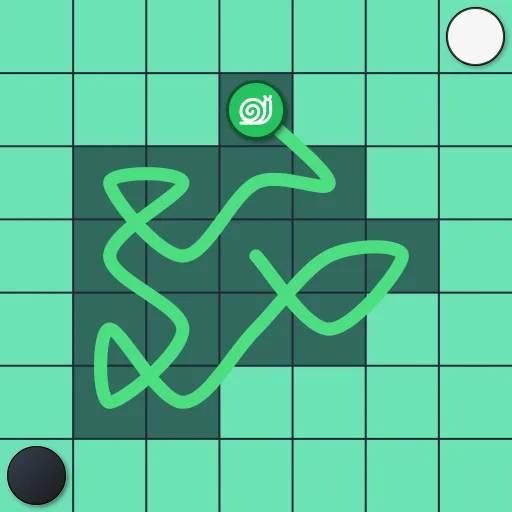
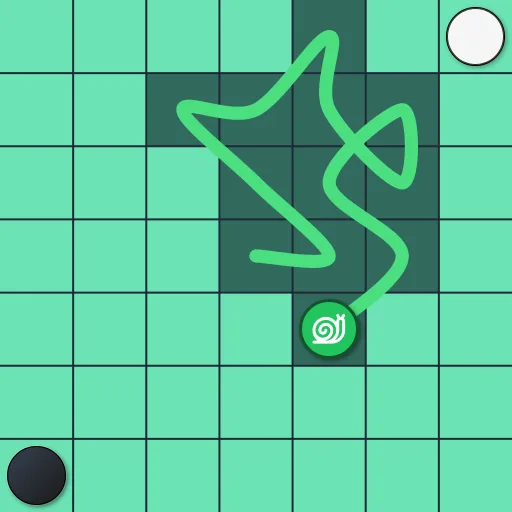
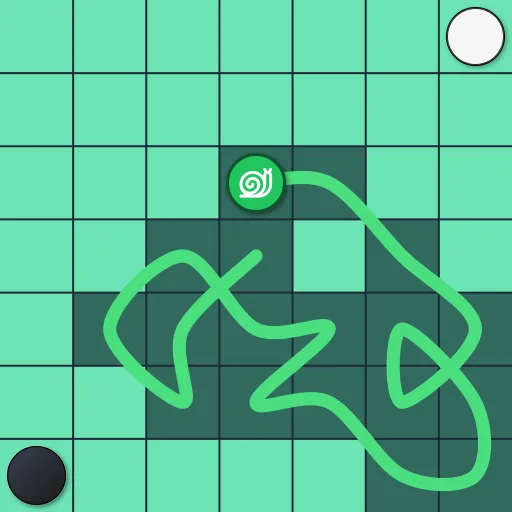
One snail starts on the centre of a 7x7 board. On your turn you move it one square in any of the eight directions onto a free square, and the square it just left is slimed and out of play for good.
You win when the snail reaches your corner, the bottom left for player 1 and the top right for player 2, no matter which player moved it there. You also win if your opponent has no legal move. There are no draws in Slimetrail.
Improve by learning strategy
Slimetrail strategy is about walls rather than speed. Each move seals a square, so ask which square your opponent needs and take that one away, and keep an open lane towards your own corner while you do it.
Watch the squares beside each goal above all else. Stepping next to your opponent's corner hands them the game, and forcing them onto the squares beside yours is how most games are actually won.
Frequently Asked Questions
Slimetrail was invented by Bill Taylor in 1992. It spread through abstract game circles and is best known in Portugal, where it is played as Rastros in national tournaments, usually on the 7x7 board with moves in all eight directions.
Yes, and it loses you the game at once. A goal square belongs to one player and wins for that player whoever pushed the snail onto it. That rule is the heart of Slimetrail: it means the squares next to your opponent's corner are a trap, and part of the game is forcing your rival onto them.
Yes. The snail moves one square per turn in any of the eight directions, diagonals included, which is the version played in Portuguese tournaments and the one used here. A simpler variant restricted to the four orthogonal steps also exists and is the one most often studied in the mathematical literature on the game.
That player loses. If it is your turn and every square next to the snail is either slimed or off the edge of the board, you have no legal move and your opponent wins. Trapping the snail is a genuine second way to win, not a rare technicality, and strong players plan for it.
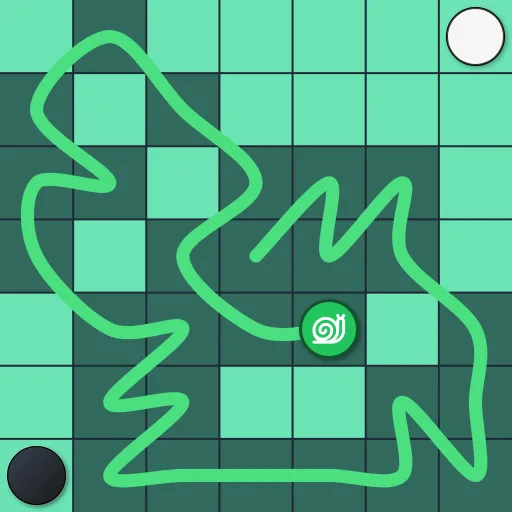
No. Every single move slimes one more square, so the board can support at most 48 moves before it runs out. Long before that, either the snail reaches a goal or the player to move is left with nowhere to go, and both of those outcomes decide the game.
Similar games you might like
If you enjoy Slimetrail, you will probably like these other abstract strategy board games.
Learn, Play, and Have Fun!
Ready to play Slimetrail online? Start a match against the computer now. No signup, no friction.