
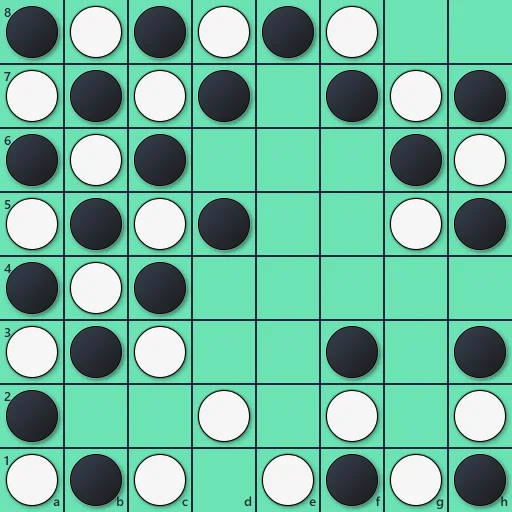
About Kōnane
Kōnane is the ancient Hawaiian abstract strategy board game of jumping stones, played on a papamu board filled with alternating black and white pieces. The rules take under a minute to learn: hop one of your stones over an adjacent enemy stone into the empty square beyond, and take everything you jump.
The depth is in what the rules leave out. There is no target square, no promotion and no material goal, only mobility, so a player who is behind on stones can still win comfortably. The player who cannot move loses, which turns the endgame into a delicate counting problem. Good players learn to think in moves rather than in pieces.
Play Kōnane vs AI
Kōnane is decided by counting the jumps each side will still have after your move. Against the computer, practise that count from the opening removal onwards, at whichever level suits you.
Learn how to open the board without feeding your opponent, how to build a reserve of safe jumps along the edges, and how to read the endgame count so you are the player still holding a move when the board runs dry.
How to play Kōnane
The goal of Kōnane is simple. Be the player who still has a legal jump when your opponent does not.
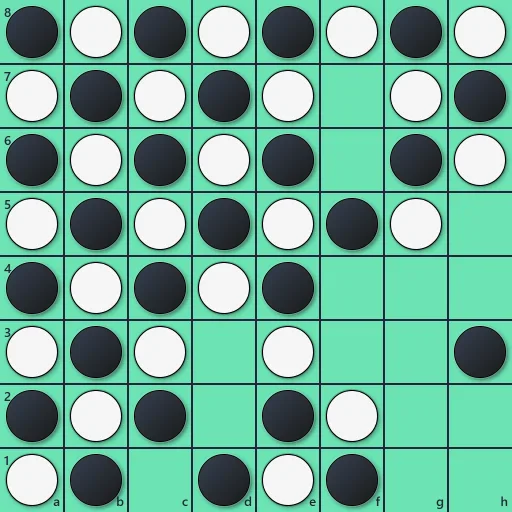
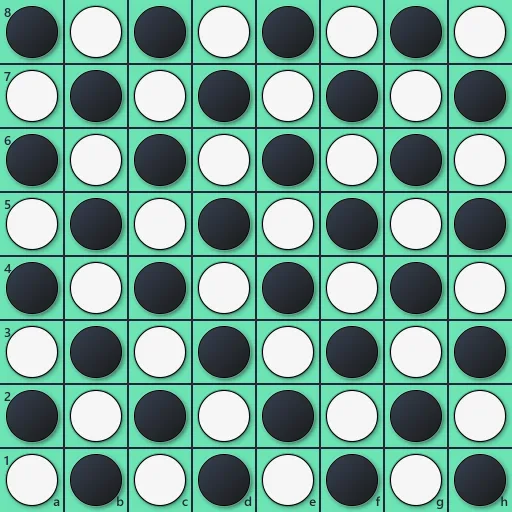
The board starts full of alternating black and white stones. Each side lifts one of their own stones to open the space, then players take turns jumping orthogonally over an adjacent enemy stone into the empty square beyond, removing every stone they leap. A chained jump may keep going in the same direction. The first player with no legal jump loses.
Improve by learning strategy
Kōnane strategy rewards players who stop counting stones and start counting moves. Strong players give up material happily when it buys them jumps their opponent cannot answer.
Keep your moves spread across many stones, build a reserve along the edges where it is hard to attack, and open the board only as fast as you need to.
Frequently Asked Questions
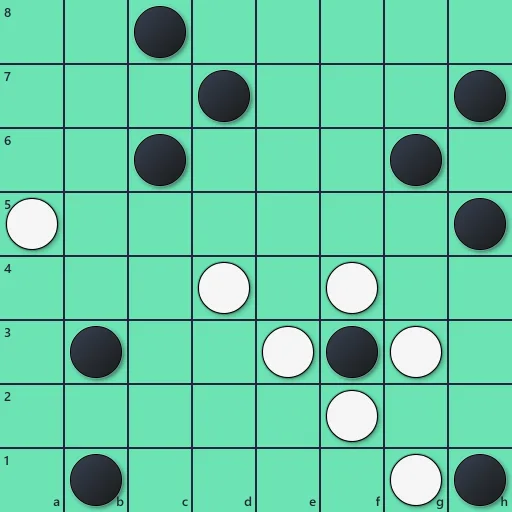
You win when your opponent begins a turn with no legal jump. Stones captured and stones remaining do not matter at all. Because every move takes at least one stone off the board, the game always ends and it can never finish in a draw.
No. All jumps are orthogonal, along a row or a column. You hop over an adjacent enemy stone and land on the empty square directly beyond it. Diagonal moves and plain non-jumping moves are not legal in Kōnane at all.
The board starts completely full with black and white stones alternating. Black removes one of their own stones from a corner or a central black square, then White removes one of their own stones orthogonally next to that gap. Black then makes the first jump.
No. A chained jump must continue in the same direction it began. You may stop after any hop in the chain, and you may only keep going while the next enemy stone is adjacent and the square past it is empty.
Traditional papamu boards varied widely, from 8x8 up to 14x17 and beyond, and archaeologists have found stone boards in many sizes across the Hawaiian islands. This version uses the 8x8 board, which is common in modern play and keeps the games sharp.
Similar games you might like
If you enjoy Kōnane, you will probably like these other abstract strategy board games.
Learn, Play, and Have Fun!
Ready to play Kōnane online? Start a match against the computer now. No signup, no friction.